

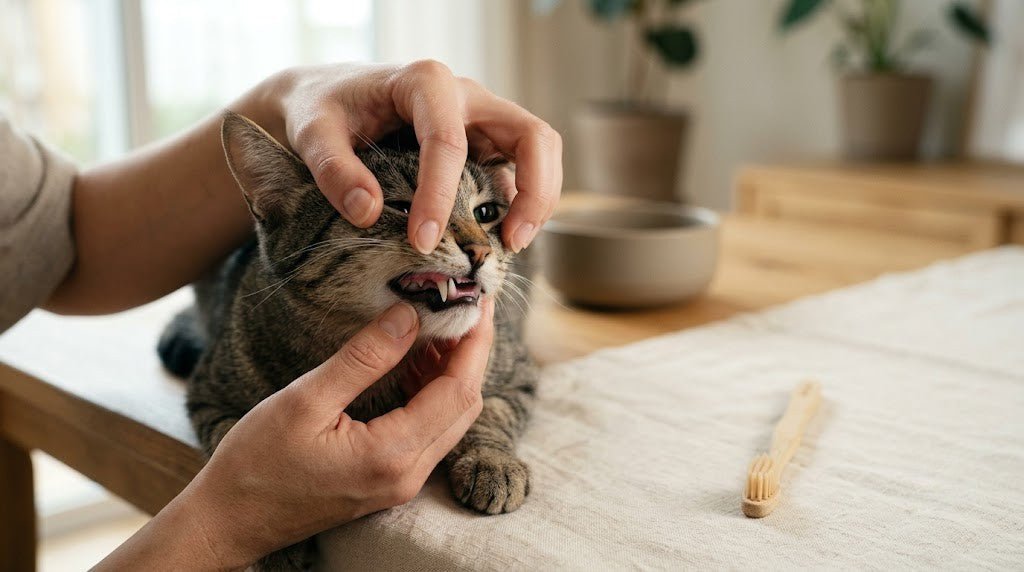
We share a deep bond with our feline companions, yet one part of their daily lives is easy to overlook: their dental health. If you have ever caught pungent "kitty breath" during a cuddle, you are not alone. Many people assume bad breath is normal, but it is one of the first signs of a preventable illness, and cat teeth cleaning is an underrated lever for extending your cat's healthy years. Veterinary research shows that by just two years of age, 70% of adult cats already have some form of periodontal disease, climbing to 70–90% by age four.
That statistic points to opportunity. By understanding feline dental health and committing to a small daily habit, you can keep your cat's teeth clean, protect your cat's long term health, and prevent mouth pain, tooth loss, and the harmful bacteria that thrive in unhealthy gums.
Summary
The hidden world inside your cat's mouth
To understand why teeth cleaning matters so much, it helps to look at how dental disease actually develops. Plaque, a sticky bacterial film, coats the cat's teeth after eating. If not brushed away, minerals in saliva harden it into tough, yellow-brown tartar. Plaque and tartar then irritate the gums, leading to gingivitis — the early stage of periodontal disease, recognizable as a red, swollen line where the tooth meets the gum tissue.
Gingivitis is reversible with proper cleaning. Left untreated, inflammation pushes deeper, destroying bone and ligaments that hold the teeth in place. This advanced stage, periodontitis, causes permanent damage and is a major driver of tooth loss and chronic mouth pain in cats. Think of it like a leaky pipe behind drywall — invisible day-to-day, but the foundation rots.
The consequences extend beyond loose teeth: every time a cat with severe dental disease chews, infected blood vessels in their gums can rupture, sending harmful bacteria to the kidneys, liver, and heart. Cats are also uniquely susceptible to tooth resorption, affecting up to 75% of cats over five. The tooth structure dissolves from the inside out. Because cats hide pain so well, they often keep eating their dry kibble through severe nerve pain, which makes a professional dental cleaning the only reliable way to spot it.
Warning signs you should never ignore
Cats are skilled at hiding discomfort, so many owners only notice dental problems when they are already advanced. Watch for mouth pain clues: bad breath, drooling, dropping food, chewing on one side, reduced appetite, pawing at the face, swelling, broken teeth, or flinching when you touch the head. Bear in mind that the symptoms may be subtle and they may still be eating despite having very painful teeth.
Any of these dental problems is a reason to schedule annual dental checkups sooner rather than later. Teeth changes — even subtle ones — usually mean oral health issues that need attention. Monitoring your pet's oral health at home is the simplest way to catch trouble early.

Why "anesthesia-free" dentistry is a myth
Once you recognize how important dental health is, the next step is scheduling a professional dental cleaning with your vet. In the veterinary world this professional dental cleaning is called a Comprehensive Oral Health Assessment and Treatment, or COHAT. Many owners feel anxious when they hear general anesthesia is required, and that fear is understandable. Some grooming businesses advertise "anesthesia-free" teeth scaling, but veterinary science strictly advises against it.
Unlike humans, cats do not sit still for a hygienist, making it impossible to safely access the subgingival area where bacteria do the most damage. Anesthesia-free scraping only removes tartar from the visible crowns, leaving disease beneath the gums untouched.
What a real professional dental cleaning includes
A genuine professional cleaning under safe, monitored anesthesia gets your cat's teeth clean and involves scaling above and below the gum line, polishing every tooth surface, a thorough oral examination, and full-mouth dental x-rays. Modern dental equipment lets your board certified veterinary dentist or your regular vet protect the airway and deliver a pain free cleaning. Because much of a cat's tooth is hidden under the gums, dental x-rays are the only way to detect bone loss, tooth decay, dead roots, or tooth resorption. Modern anesthesia is monitored and tailored to your cat's age and health, so most cats wake up comfortable. Professional cleanings include scaling, polishing, dental imaging, and any required extractions of diseased teeth, all in one visit. Catching dental issues at this stage often saves one or two teeth that would otherwise be lost.
How much does it cost to clean a cat's teeth, and is it worth having cat's teeth cleaned?
Can a dental cleaning cause TMJ (Temperomandibular Joint) Disorders?

Taking matters into your own hands: Home brushing 101
While your vet handles the deep dental cleaning, the secret to clean teeth lives in your hands. Brushing is the gold standard for keeping teeth clean and preventing plaque buildup. Despite that, only 4% of cat owners brush their pet's teeth daily. Daily brushing is ideal, but two to three times per week still reduces tartar meaningfully.
The idea of approaching your cat with a toothbrush sounds like a recipe for scratches, but with patience most cats can learn to tolerate — and even enjoy — the routine. Building it around your cat's tolerance and cat's temperament is everything.
How to remove plaque from cat's teeth at home
Start slowly and in a healthy mouth. If your cat has existing dental disease, their gums and mouths are likely to be painful. They should get professional help first before instituting a home based cleaning program.
For the first few days, spend a minute on teeth and gum massage by rubbing your cat's cheeks and muzzle while offering praise and a yummy treat. The goal is to make face-handling predict rewards, and that brief teeth and gum massage doubles as a check on dental issues. Next, gently lift the lip and dip your finger in tuna water or pet safe toothpaste and glide it over the outside of the teeth.
Once comfortable with your finger, gently lift the lip and upgrade to gauze, a finger brush, or a soft-bristled toothbrush to actually get the teeth clean — a finger brush is especially useful for cats new to dental care, and a toddler's toothbrush works well for a cat's tiny mouth. Just a small dab of cat toothpaste is plenty. Never use human toothpaste: it contains detergents and fluoride that are toxic to cats since pets cannot rinse and spit. Cat specific toothpaste is safe to swallow and comes in flavors like poultry or seafood. Dental gel is excellent for cats that resist brushing; a dab of dental gel rubbed along the gum line still disrupts plaque biofilm. Even brushing the outside surfaces of the cheek teeth for a few seconds is a powerful step in any pet dental care routine and helps prevent gum disease and oral health issues.

Practical alternatives to brushing
If your cat refuses a toothbrush, do not be discouraged. There are still excellent, scientifically backed ways to keep your furry companion's teeth clean, get the back teeth clean, and protect their kitty's oral health.
Passive home care includes dental diets, dental treats, water additives, and specially designed chew toys. Standard kibble shatters and leaves residue, but veterinary dental diets use a fibrous matrix: the tooth sinks in and fibers scrub plaque off the surface. Chew toys designed for cat's teeth provide a similar mechanical benefit and double as enrichment.
When shopping for any dental treats, chew, or water additive, look for the Veterinary Oral Health Council (VOHC) Seal of Acceptance. The VOHC is an independent panel of veterinary dentists that reviews scientific data to verify a product actually slows plaque and tartar and helps keep your cat's teeth clean. If your furry companion's teeth still show buildup despite passive measures, talk with your vet or consult with pet health experts about whether daily brushing, dental gel, or earlier regular dental checkups can prevent gum disease before it triggers tooth loss.

Empowering your cat's future
Your cat's dental health is a vital pillar of their overall physical health. By understanding the silent progression of gum disease, recognizing the necessity of safe, anesthetized professional cleanings, and committing to a small daily home routine of dental care for your cat's teeth, you protect them from painful oral health problems and from systemic complications that follow neglected oral health.
Start today. Lift the lip, look at the gums and teeth, and smell the breath. If you see redness, notice plaque and tartar, or smell something foul, schedule a visit to your veterinary clinic for a read on your cat's dental health. Between professional cleanings, keep their teeth clean at home with a pet-safe toothbrush or VOHC-approved dental treats, set a reminder for annual dental checkups, and spend one minute a day on your feline friend's teeth. That small investment, repeated over years, gives your feline friend a longer, happier life. (This article is educational and does not constitute medical advice; your veterinarian can tailor the routine to your pet's condition and your cat's tolerance.)

Dr. Ingrid De Wet
Dr. De Wet brings 15 years of small animal expertise to personalized veterinary care through in-clinic work and emergency teleconsultations, contributing to pet health education while drawing on personal experience as a pet owner to understand the emotional and practical aspects of pet healthcare.
The information in this article is based on the following scientific publications:
- Elliott, J., & Grauer, G. (Eds.). (2006-2007). BSAVA Manual of Canine and Feline Nephrology and Urology (2nd ed.). BSAVA Publications.
- Villiers, E., & Blackwood, L. (Eds.). (2005). BSAVA Manual of Canine and Feline Clinical Pathology (2nd ed.). BSAVA Publications, Glouceste
- Horwitz, D. F., & Mills, D. S. (Eds.). (2009). BSAVA Manual of Canine and Feline Behavioural Medicine (2nd ed.). BSAVA Publications, Gloucester
- Harvey, A., & Tasker, S. (Eds.). BSAVA Manual of Feline Practice: A Foundation Manual. BSAVA Publications
- Rendle, M., & Hinde-Megarity, J. (Eds.). (2022). BSAVA Manual of Practical Veterinary Welfare (1st ed.). BSAVA Publications.
Looking for a solution? Start here
Stylla Mobility for cats
Supports mobility and active lifestyle
- Helps maintain healthy joints and mobility
- Supports cartilage and connective tissue function
- Encourages an active lifestyle
Made in Switzerland with strict quality standards


