

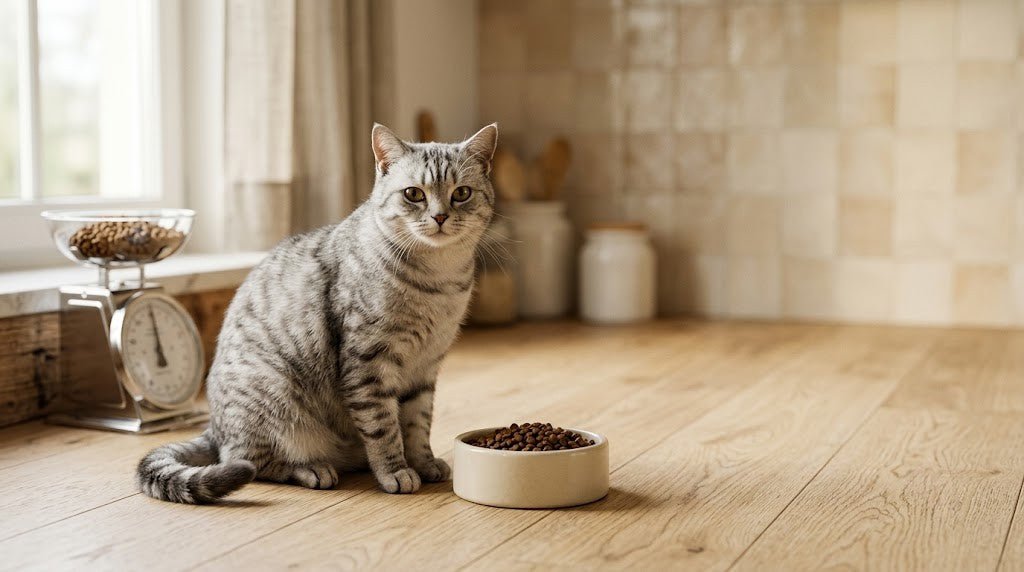
As pet parents, we show love through food, and that impulse has quietly fueled a health crisis. Figuring out how to help cat lose weight is now a routine conversation in veterinary clinics, and helping your cat lose weight is one of the most impactful health decisions you can make. According to veterinary sources, excessive weight gain is the most common nutrition-related disorder seen in companion animals today. In middle-aged cats between five and eleven years old, an astonishing 44% are classified as overweight or obese — millions of cats whose joints, hearts, and pancreases carry a load they were never designed for.
Extra calories add up fast. A cat that eats just 10 extra kilocalories above their daily requirement — a few kibbles — will accumulate about a pound of fat over a year. For the average cat, that single extra pound is a 10% increase in total body weight. Because cats hide weight gain under thick fur, by the time you notice your cat's weight has crept up, they may already be above their ideal body weight. The good news: with a clear plan, you can help your cat lose weight safely and steadily — the steps below show exactly how to help your cat lose weight without risking their health.
Summary
Why your cat's weight matters more than you think
The hidden health risks of extra ounces
An overweight cat faces a significantly higher risk of type II diabetes mellitus. Excess body fat promotes insulin resistance, which eventually exhausts the pancreas and tips the body into diabetes. Cat obesity makes a cat roughly three times more likely to develop diabetes than a cat in normal weight condition, and managing cat obesity — by helping your cat lose weight — is one of the strongest preventive levers we have.
Extra weight also strains your cat's joints, raising the risk of osteoarthritis and lameness — chronic pain that limits jumping, play, and grooming. An overweight cat is also more prone to lower urinary tract issues, high blood pressure, kidney and liver disease, and skin problems. Most importantly, obese cats experience a decreased life expectancy compared to their normal weight counterparts. These health risks make helping your cat lose weight one of those serious medical conditions hiding in plain sight, not just cosmetic.

Knowing where you stand: Assessing your cat's body condition
Because cats come in many shapes and sizes, relying solely on a number on a scale can be misleading. Veterinary professionals use a tool called the body condition score (BCS), typically a 9-point scale used to evaluate a pet's body fat. The BCS gives you and your vet a shared language for your cat's body condition that goes beyond pounds and ounces.
The body condition score scale
A simple at-home assessment
You can run a simplified at-home check in three steps:
The rib check: Gently run your hands along the sides of your cat's chest. You should easily feel the ribs beneath a thin layer of fat. If you have to press hard, your cat is likely overweight.
The waistline view: Look down at your cat from above while they stand. You should see a distinct narrowing — a visible "waist" — just behind the rib cage.
The tummy tuck: Look at your cat from the side. The belly should tuck up slightly behind the rib cage, not hang down or sit level with the chest.
If your cat fails two or more of these checks, it is a signal to schedule a visit to your veterinary clinic and start mapping out a structured plan together.

How do I decrease my cat's weight? The right diet matters
Why "less of the same food" doesn't work
Avoiding free feeding and getting portions right
Avoid free feeding, where the food bowl stays topped up. Free feeding hides how many calories your cat eats and is a leading driver of weight gain. Switch to two or three measured meals daily. A kitchen scale or measuring cup is essential — even a few extra kibbles can stall weight reduction. After each meal, the empty food bowl is your friend; it tells your cat mealtime has ended. Resist refilling with more food when your cat begs — offer water, a play session, or low calorie treats from the daily allowance.
Wet food, high protein, and low-carb options
Treats and snacks done right

The danger of fasting and rapid weight loss
When you start a weight loss plan, you must ensure your cat is actually eating. Never put a cat on a crash diet or allow them to fast. If a cat — especially an obese cat — stops eating or experiences severe caloric restriction, their body rapidly mobilizes fat stores to the liver for energy. The feline liver is not equipped to process this massive influx of fat.
Hepatic lipidosis: why slow weight loss saves lives
This metabolic overload can lead to a potentially fatal condition called feline idiopathic hepatic lipidosis, also known as fatty liver disease. It is one of the most serious risks of rapid weight loss; a cat with even a few days of food refusal can develop fatty liver disease before the owner notices. This is why gradual weight loss, careful diet transitions, and steady monitoring are so important. If your cat suddenly refuses food during a weight loss plan, treat it as urgent and contact your veterinary team the same day.
How can I get my indoor cat to lose weight? Boosting activity
Turning meals into hunting games
Daily play sessions and laser pointers

How long should it take a cat to lose 3 pounds?
Setting realistic goals
Monitoring with regular weigh-ins
Is there a 3-3-3 rule for cats?
The "3-3-3 rule" comes from adoption: 3 days to decompress, 3 weeks to settle into a routine, 3 months to fully feel at home. It is not a weight loss protocol, but it is useful here: any cat starting a new diet, feeding schedule, or exercise routine deserves the same patience. Expect resistance for the first few days, gradual acceptance over a few weeks, and visible body composition changes only after two to three months. Not all cats progress at the same pace; judging the weight loss plan in week one almost guarantees you give up before it works.

The long game: Maintaining your cat's healthy weight
Once your cat has worked to lose weight and reaches their target, the work shifts to lifelong weight management. Nearly half of pets experience rebound weight gain if old feeding habits return. Keep portion control in place for life, weigh food rather than estimating, sustain weight reduction through enrichment with puzzle feeders, and continue play. Weight management also means watching for relapses — a thin cat needs different support than one with a few extra pounds, and underlying medical conditions can change the picture, so ongoing veterinary check-ins matter.
By combining a formulated diet, portion control, an active lifestyle, and steady monitoring, you help your cat lose weight steadily, drop those extra pounds, defend their healthy weight, and give them a longer, more vibrant life. For personalized guidance along the way, consult with pet health experts.

Dr. Stefan Novevski
Dr. Stefan Novevski is a licensed veterinarian at a small animal clinic specializing in internal medicine, reproduction, dermatology, nutrition, and animal welfare, who continuously updates his expertise through professional development and international clinical experience while prioritizing client education for optimal pet health outcomes.
The information in this article is based on the following scientific publications:
- Elliott, J., & Grauer, G. (Eds.). (2006-2007). BSAVA Manual of Canine and Feline Nephrology and Urology (2nd ed.). BSAVA Publications.
- Villiers, E., & Blackwood, L. (Eds.). (2005). BSAVA Manual of Canine and Feline Clinical Pathology (2nd ed.). BSAVA Publications, Gloucester
- Horwitz, D. F., & Mills, D. S. (Eds.). (2009). BSAVA Manual of Canine and Feline Behavioural Medicine (2nd ed.). BSAVA Publications, Gloucester
- Harvey, A., & Tasker, S. (Eds.). BSAVA Manual of Feline Practice: A Foundation Manual. BSAVA Publications
- Rendle, M., & Hinde-Megarity, J. (Eds.). (2022). BSAVA Manual of Practical Veterinary Welfare (1st ed.). BSAVA Publications.
Looking for a solution? Start here
Stylla Ideal Weight for cats
Supports optimal weight balance with amino acid-based formulation
- Helps maintain a healthy weight and metabolism
- Supports energy regulation with L-Carnitine and Taurine
- Formulated with high-quality ingredients
Made in Switzerland with strict quality standards


