

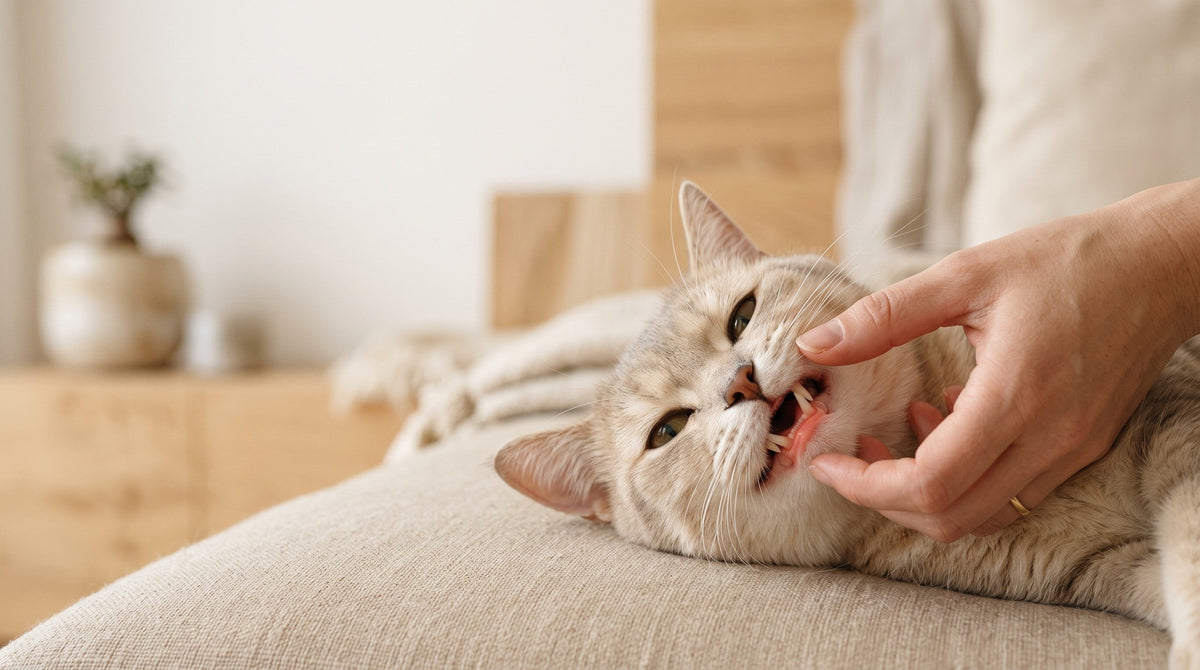
Your favorite feline climbs onto your chest for a snuggle, leans in for a nudge, and suddenly you are hit with unmistakably unpleasant bad breath. That sour kitty breath is often the very first whisper of cat gingivitis, the earliest stage of dental disease in cats. Veterinary research shows that by two years old, 70% of cats already show gingivitis in cats or full periodontal disease on their teeth.
Gingivitis is the initial, reversible stage of dental disease, but because cats are masters of hiding discomfort, feline gingivitis on cats' teeth often goes unnoticed even by dedicated owners. Understanding what gingivitis in cats looks like and how to prevent gingivitis is one of the most empowering steps you can take for your cat's oral health.
What gingivitis in cats really is
Every time cats eat, a sticky film called plaque forms on the tooth surfaces of your cat's teeth. Plaque is a biofilm of bacteria, food debris, and dead skin cells. At first the plaque accumulation stays on the upper crown of the teeth, but the bacteria eventually reach the gum line, where the gums meet the tooth root just below where the teeth meet the soft tissue.
When bacteria reach the gums, your cat's immune system mounts an inflammatory response. White blood cells release enzymes that irritate the oral tissues — the redness and swelling we call gingivitis in cats. The gums react, lose their grip on the teeth, and a tiny periodontal pocket opens between gum and tooth.
In healthy cats that pocket sits under one millimeter; once gingivitis sets in it widens, letting bacteria creep toward the tooth root. If soft plaque is not removed, it absorbs minerals and hardens into dental calculus (also called tartar), which can only be removed by professional treatment.

Common signs of gingivitis in cats
Because cats cannot tell us when their mouths hurt, you must learn to identify signs early. Halitosis is typically why cats land on the dental exam table. Other clinical signs of gingivitis in cats include:
Red or swollen gums along the gum line, sometimes mirrored on other cats gums in multi-cat households
Bleeding gums on chew toys or when you brush the teeth
Drooling, head shyness, or chewing on only one side of the teeth
Yellow-brown tartar on the canine teeth and back teeth
If you gently lift your cat's lip, the warning signs are usually clear: instead of healthy coral pink, the tissue bordering the teeth looks angry, red, and swollen. Severity varies — some cats show feline gingivitis with only mild plaque, while other cats' gums respond more dramatically.
A common myth is "my cat is still eating, so the teeth must be fine," but the survival drive overrides oral pain. Affected cats simply swallow kibble whole or chew on the other side of the cat's mouth, suffering quietly.

Why severe cases of gingivitis in cats matter
Gingivitis represents the very first stage of periodontal disease, with zero attachment loss — meaning gingivitis is completely reversible with proper oral care. Untreated gingivitis, however, marches beneath the gumline into more advanced disease, destroying the bone and ligaments that anchor the teeth.
Once that happens the damage cannot be reversed, and severe gingivitis often progresses to tooth loss and the need to extract several teeth.
The fallout extends beyond the cat's mouth. Each time cats with severe disease chew, fragile blood vessels at the gum line can rupture, letting oral bacteria enter the bloodstream and damage kidneys, liver, and heart. Managing dental care early is one of the simplest ways to protect cat's quality of life.

Risk factors: Why some cats are at higher risk
Genetics, age, and underlying illness all play a role. Senior cats, immunocompromised cats, and cats requiring chronic medication tend to develop gingivitis faster. Conditions like feline leukemia virus, feline calicivirus, and autoimmune diseases worsen the immune response in oral tissues.
Chronic inflammation can also drive tooth resorption — a painful process where the cat's own cells dissolve tooth structure — and gingival hyperplasia, an overgrowth of gum tissue. Tooth resorption is one of the most under-recognized causes of cats' tooth pain. Affected cats often need more frequent cleanings.
Can cats survive gingivitis?

Gingivitis treatment: Professional care first
If your cat's gums are inflamed, schedule a Comprehensive Oral Health Assessment and Treatment, or COHAT, with your general veterinarian or, for severe cases, a board-certified specialist in animal dentistry. Veterinary dentists handle the most complicated cases and tooth extractions; more complex oral examinations are reserved for cats with stomatitis or extensive resorption.
A proper COHAT runs under general anesthesia. Anesthesia is essential because the most damaging bacteria sit beneath the gum line, and dental x rays and probing cannot be done safely on an awake cat. We do not recommend anesthesia free dentistry: it scrapes only visible tartar and gives a false sense of security.
Under anesthesia your vet uses an ultrasonic scaler to remove dental calculus, polishes the tooth surfaces of every tooth, takes dental x images, and flushes periodontal pockets.

Building an at-home dental care routine
Within 24 hours of a cleaning, plaque bacteria recolonize the teeth, so daily brushing is the gold standard for preventing recurrence. Use a soft-bristled brush and a veterinary-approved paste on every tooth — never human toothpaste, as fluoride can cause stomach upset. Introduce tooth brushing slowly: let cats lick the meat-flavored paste off your finger, then add the brush over a few weeks.
If your cat refuses brushing, dental treats, water additives, and chlorhexidine rinses from pet supply stores can also help. Look for products carrying the Veterinary Oral Health Council seal, which means they have been independently tested to slow plaque accumulation.
Annual dental cleanings, paired with proper oral care at home, dramatically lower the risk of severe disease.

Conclusion
Cat gingivitis is incredibly common but highly preventable. By spotting bad breath, red and swollen gums, and bleeding gums on your cat's teeth, you can catch dental disease before permanent damage sets in. Remember, your cat's willingness to eat does not mean cats are pain free, and oral pain is one of the most under-recognized sources of suffering in cats. By partnering with your vet for routine dental cleanings and committing to daily brushing of cats' teeth, you can reverse gingivitis entirely, protecting your cat's mouth, immune system, and overall quality of life. Unsure where to start? Speak to our pet health experts.

Dr. Stefan Novevski
Dr. Stefan Novevski is a licensed veterinarian at a small animal clinic specializing in internal medicine, reproduction, dermatology, nutrition, and animal welfare, who continuously updates his expertise through professional development and international clinical experience while prioritizing client education for optimal pet health outcomes.
The information in this article is based on the following scientific publications:
- Elliott, J., & Grauer, G. (Eds.). (2006-2007). BSAVA Manual of Canine and Feline Nephrology and Urology (2nd ed.). BSAVA Publications.
- Villiers, E., & Blackwood, L. (Eds.). (2005). BSAVA Manual of Canine and Feline Clinical Pathology (2nd ed.). BSAVA Publications, Gloucester
- Horwitz, D. F., & Mills, D. S. (Eds.). (2009). BSAVA Manual of Canine and Feline Behavioural Medicine (2nd ed.). BSAVA Publications, Gloucester
- Harvey, A., & Tasker, S. (Eds.). BSAVA Manual of Feline Practice: A Foundation Manual. BSAVA Publications
- Rendle, M., & Hinde-Megarity, J. (Eds.). (2022). BSAVA Manual of Practical Veterinary Welfare (1st ed.). BSAVA Publications.
Looking for a solution? Start here
Stylla Mobility for cats
Supports mobility and active lifestyle
- Helps maintain healthy joints and mobility
- Supports cartilage and connective tissue function
- Encourages an active lifestyle
Made in Switzerland with strict quality standards


