

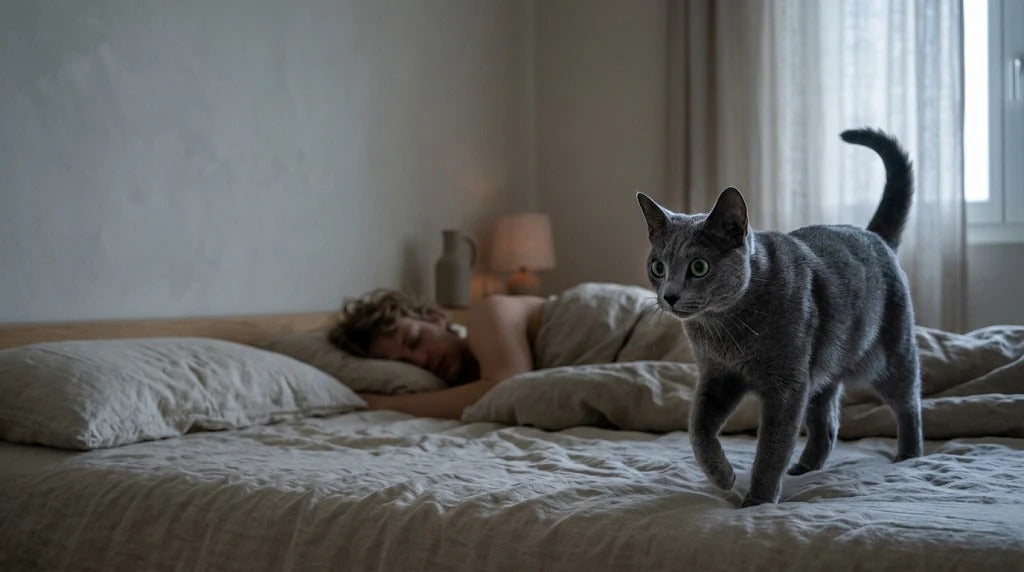
It is 3:00 AM, and your home is quiet, until a piercing meow echoes down the hallway and tiny paws pace across your bedroom floor. If you have a restless cat at night, you are far from alone: nighttime restlessness is one of the most frequent behavioral concerns pet owners raise with their vet. You might be tempted to dismiss midnight meowing as mischief or an inevitable part of aging, but science paints a very different picture.
As a veterinarian, I see nocturnal activity not as an annoying habit but as a form of communication. When your cat wakes you at night, it offers a direct window into their physical, emotional and mental well-being. Whether the cause is rooted in evolutionary biology, an age-related medical condition or a subtle environmental stressor, understanding it is the first step toward restoring peaceful sleep for both of you.
Summary
Is it normal for cats to be active at night?
To a degree, yes. Cats are crepuscular animals, meaning their peak activity and hunting drive fall at dawn and dusk, the twilight hours when small prey such as rodents, birds and insects are on the move. In the wild, cats spend their energy in short, high-intensity bursts that take up about 9% of their daily time budget, catching 10 to 20 small meals spread across the day and night.
Modern indoor life, however, creates a biological mismatch. Many indoor cats spend long, quiet hours resting while their families are at work or school, and much of that daytime is spent in light sleep. By bedtime, your cat has stored up a day's worth of pent-up energy, and with no outlet for stalking, pouncing or foraging, their internal clock triggers a surge of activity.
Those late-evening zoomies, especially common in a kitten or young adult cat, are often simply a hunting instinct with nowhere else to go. From your cat's point of view, the middle of the night is an ideal time to hunt, explore and seek your company.

Why is my cat restless at night all of a sudden?
A sudden change always deserves your attention. When a cat that used to sleep through the night becomes restless at night over a few days or weeks, something has usually shifted, either in their body or in their world. Before assuming the pacing is purely behavioral, book a check-up with your vet, particularly if your cat is over seven years old, because new nighttime patterns are often the first visible sign of an underlying health problem.
If your cat is healthy, take a closer look at their routine and environment. Boredom is a major driver in indoor cats whose days lack stimulation. Hunger can also wake a cat in the small hours, especially if the last meal is served early in the evening. Changes in the household, such as a move, a new pet, a new baby or friction between housemate cats, can raise anxiety, and so can the sight of stray cats patrolling outside the window at night. Unspayed females in heat may also become noticeably vocal and restless.

Why is my senior cat restless at night?
Night waking becomes more common with age, and in a senior cat it is rarely "just old age". Four medical conditions frequently show up first as nighttime restlessness, and each one is treatable or manageable once diagnosed.
Cognitive dysfunction and the aging brain
Feline cognitive dysfunction syndrome is a progressive neurodegenerative disorder often compared to Alzheimer's disease in people. Studies show that roughly 28% of cats aged 11 to 14 years, and up to 50% of cats over 15 years, are affected by cognitive decline. To assess it, vets use the DISHAA framework: disorientation, altered social interactions, sleep-wake cycle changes, house soiling, activity changes and anxiety.
Changes in the brain, including loss of nerve cells and altered neurotransmitters (the chemical messengers between nerve cells), disrupt the body's daily rhythms. An older cat with cognitive dysfunction may wander aimlessly at night, seem lost in familiar rooms or yowl loudly in a dark hallway.
Can hyperthyroidism or pain make a cat restless at night?
Yes, both are common culprits. Hyperthyroidism (overactive thyroid gland) is the most frequent hormonal disorder in older cats, typically diagnosed around 12 to 13 years of age. It occurs when a benign growth on the thyroid gland produces too much thyroxine (T4 or thyroid hormone), the hormone that sets the body's metabolic rate. The effect is much like an engine stuck in overdrive: nervous energy, aimless pacing, night howling and a ravenous appetite alongside weight loss and muscle wasting.
High blood pressure, or systemic hypertension, often develops alongside chronic kidney disease or hyperthyroidism. Over time it damages delicate organs, including the brain, and an older cat affected this way may vocalize at night, pace or appear suddenly distressed, agitated or become aggressive.
Pain is the fourth major cause, and one that is easy to miss. Osteoarthritis affects over 60% of cats older than six years and more than 90% of cats over 12. Cats are experts at hiding pain and rarely limp openly; instead, stiff, inflamed joints make it hard to find a comfortable resting position, so the ache wakes them and they shift, pace or cry out. Lower urinary tract disease, digestive discomfort and sensory loss, such as hearing loss or vision loss, can cause similar distress in the dark hours.

Should I ignore my cat when it wakes me up at night?
Once your vet has ruled out medical causes, the honest answer is yes, gently and consistently. Often, night waking is kept alive by learning. Cats learn fast, and if your cat meows or paws at your face at 3:00 AM and you respond, even with a sigh, a few words or a trip to the food bowl, you have rewarded the behavior. To your cat, the attention-seeking strategy worked.
When you start ignoring the behavior, you will often meet an "extinction burst": for a short time, the meowing gets louder and more frequent because a trick that used to work has suddenly stopped working. Giving in during this phase teaches your cat that more persistent vocalization pays off, which deeply entrenches the habit. Hold steady for a week or two while making sure every need is met during the day, and the attention-seeking usually fades. Never punish a restless cat; it only adds stress and anxiety.

How do I calm a restless cat at night?
Restoring a peaceful night calls for a compassionate plan that meets your cat's physical, emotional and instinctual needs:
Rule out illness first: a full check-up with blood work (including a complete blood count, a biochemistry panel and a total T4 test), a urine test, a blood pressure measurement and an orthopedic exam can catch hidden causes early.
Build a play-eat-sleep routine: spend 10 to 15 minutes in interactive play with a wand toy before bedtime, letting your cat stalk, chase and "catch" their prey.
Add daytime enrichment: window perches, a cat tree and rotating toys keep boredom at bay while you are away, so less energy is saved for the night.
Use food for foraging: a puzzle feeder satisfies the hunting instinct, and an automatic feeder set to open around 4:00 AM shifts your cat's focus away from your bedroom door.
Adapt the home for age: older cats benefit from a low-sided litter box, ramps near favorite perches, a cozy bed in a warm spot and a soft night light.
Ease anxiety: a synthetic feline facial pheromone diffuser can help cats who are unsettled by changes in their environment.
Does feeding my cat before bed help it sleep through the night?
Often, yes. Serving a satisfying meal straight after the evening play session mimics the natural sequence of hunting, eating and resting. A full stomach naturally brings on a period of rest, which can carry your cat through several hours of sleep. If hunger still wakes them early, splitting the daily food allowance so a portion is saved for the bedtime meal or the automatic feeder usually solves the problem without increasing total calories.
Should my cat sleep in my bedroom?
There is no single right answer. Some cats settle best curled up beside their people, while others treat the bedroom as a playground. If sharing your room leads to paw taps and early wake-up calls, it is fine to keep the bedroom door closed, as long as your cat has a safe space elsewhere with a comfortable bed, water, toys and everything else they need. What matters most is consistency: decide on the arrangement and stick to it every night.

When should I worry about my cat being restless at night?
Contact your vet promptly if the nighttime restlessness is new or getting worse, or if it comes with other changes: weight loss despite a big appetite, increased thirst or urination, accidents outside the litter box, confusion, stiffness or reluctance to jump, or loud yowling that seems distressed rather than demanding. In a senior cat, these signs point to treatable conditions such as hyperthyroidism, high blood pressure, cognitive dysfunction or arthritis pain, and early treatment makes a real difference to comfort and quality of life.

Bringing calm back to your nights
Your cat's peaceful nights are not a matter of luck; they are the result of meeting their biological, medical and emotional needs. When you see nighttime restlessness as a symptom rather than a character flaw, the path forward becomes clear: rule out illness with your vet, give your cat enough daytime enrichment and interactive play, build a predictable bedtime routine and stay consistent. With patience, most restless cats, and their owners, can enjoy quiet nights and a good night's sleep once again.

Dr. Ingrid De Wet
Dr. De Wet brings 15 years of small animal expertise to personalized veterinary care through in-clinic work and emergency teleconsultations, contributing to pet health education while drawing on personal experience as a pet owner to understand the emotional and practical aspects of pet healthcare.
The information in this article is based on the following scientific publications:
- Elliott, J., & Grauer, G. (Eds.). (2006-2007). BSAVA Manual of Canine and Feline Nephrology and Urology (2nd ed.). BSAVA Publications.
- Villiers, E., & Blackwood, L. (Eds.). (2005). BSAVA Manual of Canine and Feline Clinical Pathology (2nd ed.). BSAVA Publications, Gloucester
- Horwitz, D. F., & Mills, D. S. (Eds.). (2009). BSAVA Manual of Canine and Feline Behavioural Medicine (2nd ed.). BSAVA Publications, Gloucester
- Harvey, A., & Tasker, S. (Eds.). BSAVA Manual of Feline Practice: A Foundation Manual. BSAVA Publications
- Rendle, M., & Hinde-Megarity, J. (Eds.). (2022). BSAVA Manual of Practical Veterinary Welfare (1st ed.). BSAVA Publications.
Looking for a solution? Start here
Stylla Calmness for cats
Supports relaxation and emotional balance with amino acid-based formulation
- Promotes emotional balance and relaxation
- Helps maintain balanced behaviour
- Supports healthy physiological equilibrium
Made in Switzerland with strict quality standards


